www.californiadroughtupdate.org/20210715-California-Water-and-Infrastructure-Report.pdf?_t=1626488419
On July 15 I did an interview on the Western and California drought for the LaRouche Political Action Committee, which will be posted on the larouchepac.com website next week. I will provide a link to it in next week’s report.
The following are some of the main points I presented in that interview:
The drought, but more importantly, the effects of it, in farm land being fallowed, hundreds of wells going dry as both farmers and residences pump more ground water, reservoir levels falling that reduces electricity generation, and even a grasshopper plague in Oregon and Montana, is the result of more than 40 years of not building water infrastructure.
But why? September 15 will be the 50th anniversary of the end of the Bretton Woods system when President Nixon removed the U.S. from the gold reserve system established by President Franklin Roosevelt. That action created the shift from a productive, scientifically driven economy of industry, infrastructure building, the space program, to one of a gambling casino run by Wall Street and London.
Now we pay the price. But, that was never necessary!
In the 1960s, during the Kennedy administration, there were two great projects proposed, and blue printed, that would have provided adequate water for not only California, but for most of the North American continent for a century to come. Those projects were the North American Water and Power Alliance and the building of nuclear-powered desalination plants.
Had those projects not been canceled, we would not have the crisis we have today. That includes that for more than 25 years now, this state has failed to deliver most years even the amount of water requested and ordered by the water districts of the state.
To be clear, there is no short-term solution to the damage caused by this drought, but only measures that will alleviate some of the crises as they come upon us– like wells going dry, and providing, in some cases, entire towns with trucked-in and bottled water.
This is the second year of the drought, and already it is more intense than the last drought of 2011-2016. And the drought is not just in California, but encompasses most of the nation west of the Mississippi River. The five year California drought saw more than 500,000 acres of the most productive agriculture in the world fallowed. This year, that number has already been surpassed.
The Colorado River Basin has been in almost continuous drought for 20 years, and the Lake Mead Reservoir behind Hoover dam is at one third of capacity– a level not seen since the dam began to fill in the 1930s. Glenn Canyon dam and its Reservoir Lake Powell, just above Hoover Dam, is also at that level. A first ever declaration of emergency shall soon result in cutbacks in water deliveries to Arizona and Nevada. As the lake level falls further, then, the other states relying on the Colorado River water will be cut, including California and Utah, Colorado, Wyoming, New Mexico and the nation of Mexico.
Already, Hoover Dam is producing 25% less electricity than when the reservoir is full. Glenn Canyon dam, also, has cut back electricity production by about 20%, and a complete shut down of it is threatened.
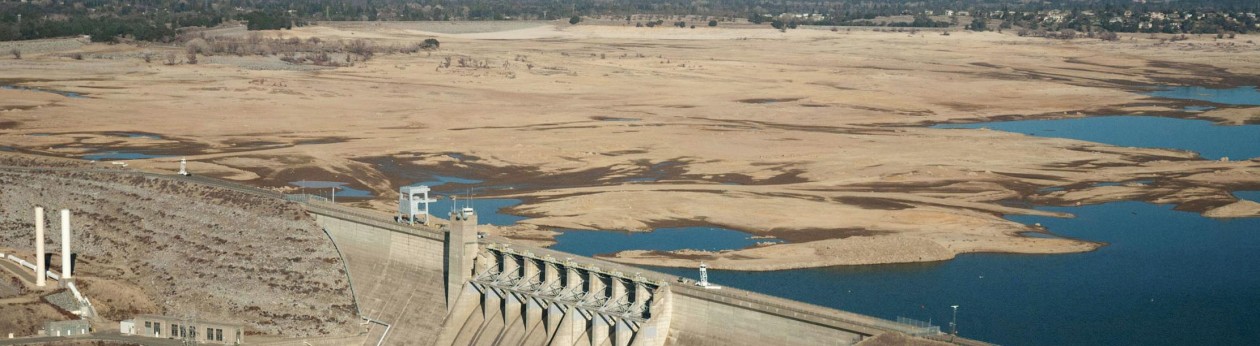
Add to that, at California’s Oroville Dam and Reservoir, it is forecast that by later this summer there will be a complete shut down of its electricity production. Oroville Dam produces 819 megawatts of electricity. A megawatt produces electricity roughly equal to the same amount of electricity consumed by 400 to 900 homes in a year (enough for about 500,00 homes).
As one scientist recently said, the entire southwest region has not been this dry in the past 1,200 years.
In fact, over the past 1,200, all but the last about 160 years the climate of this region was characterized by alternating megadrought and megafloods. This past century and one-half has been the “wettest” period of the last millennium.
Wildfires, which usually do not become serious until late summer, have exploded throughout the western states. At least 60 are now burning with the Bootleg fire in Oregon, on the California border, already larger than 220,000 acres. With the drought, fuel for the fires is exceptionally dry and the fires are explosive, generating their own weather, including lightning, which can start more fires.
Last year saw a new California record of more than 4.2 million acres burn, and already this year there have been more than 4,300 fires, about 500 more than at this time last year. That 4.2 million acre record, at this rate, will be surpassed this year.
Further threatening California’s electricity supply, the Bootleg fire, just north of the Oregon-California border, has already partially shut down the power lines that feed electricity from the Pacific Northwest to California. These power lines are called the California-Oregon AC Intertie, which can carry about 4,800 megawatts of power, enough to serve millions of homes. The intertie is operated by the Bonneville Power Administration, created by President Franklin Roosevelt as part of the great project of dam building on the Columbia River and its tributaries.
The California’s Independent Systems Operator, which runs the California grid, is already facing shortages, and has issued alerts for customers to cut back on electricity use. Last year there were several days in which thousands of people were cut off for days at a time. It could well be worse this year. Especially since the state has put all its eggs in the so-called renewables basket of solar and wind.
It will get worse in the years ahead as the remaining nuclear power plant in California, the Diablo Canyon plant, is scheduled for shut down in 2025, though Congressman Devin Nunes this past week introduced a bill in Congress to keep it open past that date. Diablo Canyon produces 2,300 megawatts of power. The insanity of reliance on solar and wind could not be more clearly threatening to California’s energy grid.
As I said, there is no short-term solution for this drought. We can only hope it will not be a megadrought, like those that characterized this region for more than 1,000 years until about the middle of the 19th century.
For the next few years ahead there are some projects for building water storage and infrastructure that must be undertaken. Among those are the proposed Sites Reservoir, near the Sacramento River. In addition, raising the height of Shasta Dam will increase the storage capacity of Shasta Lake by nearly one million acre feet. Both will take several years to complete. Finally, the building of more desalination plants can be begun immediately, and they can come on line in one or two years. Some of them must be in San Francisco Bay, where they can pump fresh water directly into the State Water Project and the Central Valley Project Aqueducts.
The following report includes updates on most of the above topics.
We conclude this week’s report with a lovely Feature on the Recall campaign against California Governor Gavin Newsom.